


Protega Protection:
Four Stage Protection
Protega Rust Stabilises Pigment combine the unique Protega technologies of rust stabilisation and self-leafing glass flake reinforcement to produce a primer and finish coat in one product. Protega Glass Flakes contain millions of heat-hardened borosilicate glass flakes which, with the self-leaf provides a continuous barrier against the environment.
The four stages are :-
 Firstly, Protega water resistant resin penetrates deeply into the firmly-adhered rust, forcing out all the moisture and oxygen present within the rust strata that would otherwise act as a catalyst to future corrosion.
Secondly, Protega reinforced rust stabilisers pigment and self-leaf glassflakes cure to form a tough, durable surface.
Thirdly, the active anti-corrosion pigment contained within the material reacts upon contact with red iron-oxide (rust) and, by an electro-chemical reaction, stabilises it to form magnetite, an inert black iron oxide. This serves to protect the steel from moisture and oxygen or other contaminants and, in bonding to steel substrate, minimises the risk of sub-flim corrosion (or 'rust creep').
And lastly, Protega reinforced rust stabilisers pigments use a patented technique of self-leafing glassflakes that laminate together to form a tough, resistant finish. This serves to protect the steel from the chemical and abrasive effects of the environment.
World Wide Protection
Protecting your investments / Worldwide Corrosion Protection
 Problem:
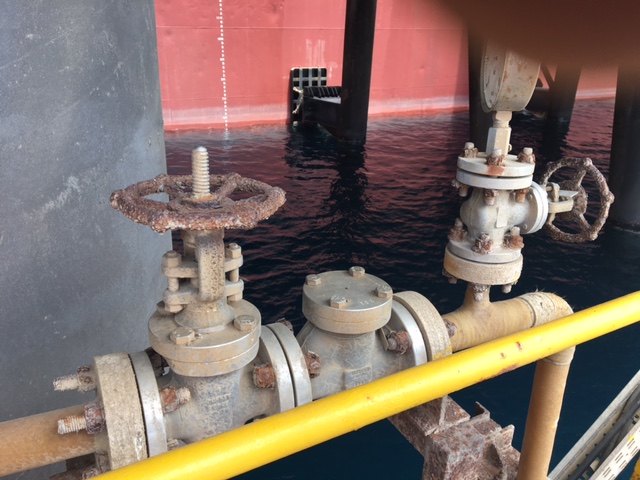
Providing a tough, durable finish which will protect against the external causes (attack) of corrosion and to provide a long term protection of the steel substrate is, the problem faced daily by engineers who are trying to extend and maintain the operating life of structures and equipment.The weakness of traditional methods of corrosion control using conventional paints are so permeable, that it allows moisture and oxygen to penetrate. The first visible signs of corrosion include peeling, cracking, blistering, flaking and chalking. However beneath the surface, the corrosion will systematically destroy the steel substrate until the structure or equipment becomes unsafe and dangerous.
 Solution:
Protega reinforced finishes use a patented technique containing millions of heat hardened borosilicate glass flakes which with a self-leaf provides a continuous barrier to the environment. As the finish dries and cures, millions of minute glass flakes self-leaf together, dramatically reduces the permeability of the finish. makes the layer impermeable. Additionally, the inherent hardness of the glass flakes reinforcement increases chemical and abrasion resistance resulting in a tough, durable finish which provides both a high level of decorative appearance and effective long term corrosion protection. Protega reinforced finishes as one element of Protega anti-corrossion systems will provide a new standard of protection in an aggressive environment.
Problem:
The protection of steel structures situated in the hostile and highly demanding conditions of continuous moisture or immersion presents a major challenge to the maintenance engineer. In these wet and abrasiveness areas, surface preparation is often severely restricted or impossible. In many environments, the steel is completely immersed in either fresh or sea water, making protection extremely difficult. Examples include ballast tanks under decks, crude oil tanks, buried or encased steelwork mines, gas works chemical plants, marine structures and jetty piles.
Solution:
Protega rust stabiliser pigments have developed a range of high performance rust stabiliser pigments and self-leaf glass flake coatings which have the ability to stabilise existing corrosion and provide complete protection in the most arduous and demanding environments. Protega is designed to be applied with minimal surface preparation onto wet, rusty or totally immersed steel.
Problem:
Complex electronic equipment, products in storage or transportation small components, equipment used only in emergency situations and other diverse applications often require effective anti-corrosion protection or monitoring. Conventional anti-corrosion methods such as painting, coating with oil or grease and wrapping in corrosion inhibitive papers are often inappropriately designed, difficult or messy to apply and very often, ineffective and expensive. No longer a preference to match the current Go Green global approaches.
Solution:
Applications such as these require a cost effective, easy to apply and appropriate method of preventing corrosion. Protega corrosion control has developed a range of corrosion inhibitors which incorporate the latest in corrosion technology to meet this need.